
Your Body Fat Scan Is a Method-Specific Estimate
After staring at your body fat scan, you're left feeling one thing: confused. Is your DXA visceral fat reading accurate? Can you really use that exact number to guide your weight-loss progress?
What this article covers
After staring at your body fat scan, you're left feeling one thing: confused. Is your DXA visceral fat reading accurate? Can you really use that exact number to guide your weight-loss progress? As it turns out, the real number doesn't actually matter.
A 1997 validation study reported DEXA precision errors of 1.1 kg for fat mass, 1.6% for fat percentage, 1.4 kg for lean tissue mass, and 0.03 kg for total body bone mineral. That same year, a DEXA validation showed a standard error of the estimate of 2.8% body mass with a mean difference of -0.4 ± 2.9% body mass versus a validated four-component model. Put simply, those numbers aren't exact: they're method-specific estimates, arrived at from different algorithms in the scorer, not objective truth.
What the scan actually measures
DEXA, BIA, and skinfold calipers all measure body composition, but do so in very different ways.
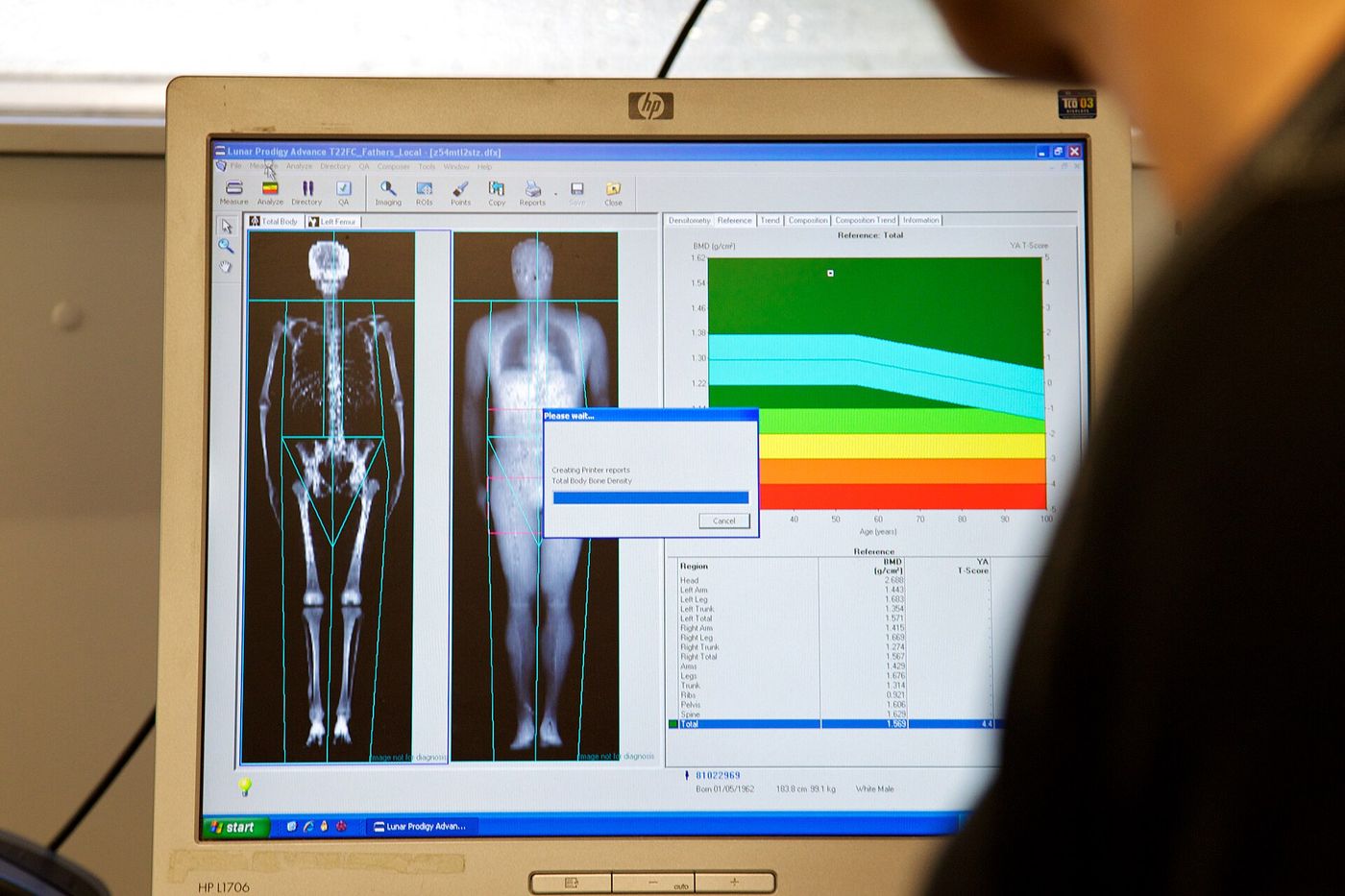
DEXA scans, also known as DXA scans or bone density scans, use X-ray technology to estimate body fat. The scan produces an image of your body that separates fat mass, lean mass, and bone mineral content. However, a 2019 backcountry-hiker study found that bioelectrical impedance analysis (BIA) underreported bodyfat by 2.1 ± 3.9% compared with Bod Pod, a top reference method. While BIA can be a useful screening tool, it's less accurate than DEXA or skinfolds, especially in more variable conditions.
Skinfold calipers measure the thickness of folds of skin and subcutaneous fat at specific body sites, such as the abdomen, sub-scapular, and triceps regions. A study of two skinfold calipers reported total error ranging from 7.9 to 10.9% body fat for digital and self-administered calipers. DEXA showed a total error of ±5.0% in older adults, depending on mode. DEXA and skinfolds both separate fat mass from soft tissue but under very different assumptions about body density.
DEXA's real margin of error
Let's get something straight: DEXA scans are not the end-all, be-all of body composition measurement. In a 1998 paper, researchers concluded that DEXA provided “encouraging, but not definitive” evidence of accurate body-composition assessment under the conditions tested. There was too much variability in the DEXA results for them to be considered a definitive measurement.
The 1997 validation study's reported DEXA precision errors were: 1.1 kg for fat mass, 1.6% for fat percentage, 1.4 kg for lean tissue mass, and 0.03 kg for total body bone mineral. That 1.6% error means that while two DEXA scans taken within a short time period of each other might show the same general fat percentage, they wouldn't necessarily have the exact same number each time. This margin of error is important to keep in mind when looking at your DEXA scan results.
In older adults, a DEXA study reported a total error of ±5.0% body fat when comparing DEXA results with a four-component model that's considered a more accurate measurement of body composition, considered more accurate. In that older-adult study, DEXA %Fat was greater by 3.9%, while bone mineral content was greater by 1.3% under array scan mode. So don't just look at the top-line body fat percentage - the errors matter.
Why bathroom scales drift more
Bioelectrical impedance analysis (BIA) is the method used by many consumer scales, including some sold by Letsfit and Fitanly. BIA works by sending a harmless electrical current through the body to measure the resistance and reactance of body tissues. Then it factors in age, sex, weight, and height, along with user-selected settings, to estimate percentages of body fat, lean mass, and water.
However, BIA results can be significantly lower than more accurate measurements, such as DEXA or skinfolds. A 2019 study found that BIA underestimated body fat by 2.1 ± 3.9% before a hiking expedition and 2.1 ± 3.8% after the expedition, compared with Bod Pod, which could indicate that assumptions about hydration adjusted for the activity. The study also found that, fat-calipers were not significantly different from Bod Pod, with differences of 0.9 ± 4.4% before the expedition and 0.3 ± 4.3% after the expedition - pretty darn close, even if small changes were lost in the noise. Any small result on a consumer scale may be lost in the error, but skinfolds held up as a reasonable estimate.
A review article from Legion Athletics points out that while calipers can be within 2.5 percent for predicting body fat from densitometry, large error margins of 3-9% can happen by anthropometry. DEXA lumps range of materials to determine tissue density; BIA estimates that from resistance, while calipers use a fixed ratio to get the job done. None of them are a direct count of body fat; all of them are subject to assumptions.
Skinfolds depend on the measurer
Accuracy in skinfold measurements can vary widely, depending on the skill and experience of the person taking the measurements. A study found that digital and self-administered calipers had total error ranges from 7.9 to 10.9% body fat, compared with other field methods. The study also found that individual predictive accuracy limits varied from ±8.6% for self-administered calipers and ±6.4% for digital calipers, suggesting that the devices generally worked, but were dependent on the observer. With good training, the error can drop lower.
Additionally, the study found that digital calipers had higher predictive accuracy than self-administered, but still showed a significant margin of error. This suggests that even with calibrated digital calipers, there is still a significant margin of error in skinfold measurements, with ±6.4%-±7.5% for men and women. So whenever you take calipers, don't count the number as the exact truth. Measure on the same side, the same time after exercise, and if possible, with the same person. Chart the change, but don't count every point as meaningful, or you'll miss the trend by chasing the number.
What to track instead of chasing one number
When it comes to body composition, it's important to focus on trends and patterns over time, rather than a single measurement. Instead, you should consider the following factors when interpreting your body composition results:
Repetition: Take repeated measurements over time with the same device and same method. Look for consistent changes, rather than isolated data points.
Consistency: Aim for consistent conditions and procedures when taking measurements.
Interpretation: Consider the context of your measurements, such as recent changes in your activity level, diet, or hydration status. Skinfold measurements, for example, are influenced by factors that cause swelling; DEXA measures lump the effect, but BIA scales are most sensitive.
Goals: Set realistic goals for yourself, such as maintaining a healthy body fat percentage within a certain range, rather than aiming for a specific percentage number.
Instead of laser-focusing on a single body fat number, track your progress over time using the same method, in similar posing, preferably by the same measurer, if possible. Measurement error matters for trend spotting, and different measurement tools use different assumptions - you'll get the best accuracy out of them by using the same tool and method every time. Compare a DEXA baseline to a DEXA followup, a BIA scale's readings to each other, and a skinfold observer to their measurements, and you get a solid guide to overall change. Any single read, though, may be off by up to the margin of error. Do consider that implied error in your expectations.
Body-fat measurements today are a trend-track, not an exact number
Looking to reduce that margin of error? When considering body composition measurements, opt for more reliable methods and prepare appropriately.
However, keep in mind that while body composition measurements can be a useful tool, they are not perfect and should not be the sole determinant of your health and fitness goals, especially because of the assumptions built into the formulas. If you are only measurement-fit, you may be seeing yourself as determined, when the tools are letting you down. Instead, focus on overall health, energy levels, and how you feel, as well as how your clothes fit, visual changes, and your own satisfaction with your progress.